
English| EUR
Suggested for you
More currencies
Choose a language
The performance at Pura Luhur Uluwatu is timed to the sun, not the clock — which is why the start shifts across the year and the seating fills long before it. This kecak fire dance uluwatu schedule guide sets out how show timing sits inside the temple's daily opening pattern, and what that means for when you actually leave your hotel.
Quick answer
The Kecak performance at Uluwatu is staged in the cliff-top amphitheatre in the final hour of daylight, and the temple itself is open 07:00–19:00 every day of the week. The recommended arrival window is 16:30–17:30. Because the show is timed around sunset rather than a fixed hour, exact start times shift by season, and seating is unreserved.
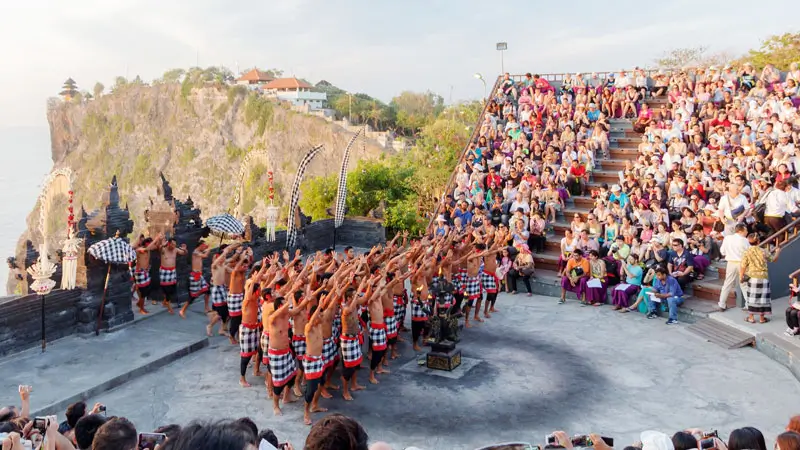
The chant has no instruments. No gamelan, no drums, no flutes — the entire soundscape of the Kecak is produced by a seated ring of men repeating an interlocking "cak" pattern, a form built in the 1930s from the older sanghyang trance ritual. That detail explains a lot about the timing. A performance driven by voice and firelight needs falling light to work, so the show at Pura Luhur Uluwatu is scheduled against the sun rather than against a fixed hour on a poster. What a visitor is actually dealing with is two clocks running at once. The first is the temple's own daily rhythm, which follows a single uniform pattern across the week rather than varying by day. The second is the amphitheatre, a stone semicircle cut into the limestone headland above the Indian Ocean, where seating is unreserved and fills from the lower tiers upward. Anyone checking a kecak fire dance uluwatu schedule is really asking about the gap between those two clocks: how much time sits between walking through the entrance and the first chant. That gap is where the whole evening is won or lost — it covers the walk along the clifftop path, the pecalang stewards directing the queue, and the macaques that patrol the railings and take sunglasses from distracted hands. Seasonality matters more here than most Bali landmarks. Uluwatu sits near eight degrees south, so sunset drifts across the year without dramatic swings, but the dry season months bring clearer horizons and larger crowds, while the wet months can push a performance into grey light or interrupt it outright. The Ramayana narrative — Rama, Sita, the monkey general Hanuman and the closing fire sequence — runs roughly an hour once it begins, ending after dark. The practical use of a schedule, then, is not memorising a start time but working backwards from it. Traffic from Seminyak or Canggu is unpredictable in the late afternoon; the Bukit Peninsula roads narrow near Pecatu. Treat the kecak fire dance uluwatu schedule as a deadline for the seating scramble, not for the curtain, and build slack into the drive. Confirm current performance timing on the day through the temple's official channels or your booking, since staging is weather-dependent and subject to Balinese ceremonial calendars.
“The show is scheduled against the sun rather than against a fixed hour on a poster.”
Uluwatu Temple is open daily, with the same visiting window throughout the week. Plan around the full weekly schedule below before arranging your Kecak visit.
No seasonal opening-hour changes are listed in the canonical facts. If the official site posts exceptional closures or temporary adjustments, they supersede this weekly schedule.
The best window is 16:30–17:30, which matches the official arrival recommendation and gives you time to settle in before the sunset-driven Kecak crowd peaks. Late afternoon is the most practical slot because the performance draws the biggest audience near sunset, so earlier arrival improves seating choice without turning the visit into a rushed check-in.
28–32°C, drier afternoons
This is the easiest season for a late-afternoon visit because skies are often clearer and sunset timing is more reliable. Plan to be in place during the official 16:30–17:30 window so you are not competing for seats at the busiest point.
27–31°C, warm and manageable
These months often give you a good balance of lighter pressure and comfortable weather for waiting before the show. The sunset rhythm still matters, so arriving in the official window remains the smart move.
27–30°C, humid; brief rain possible
Crowds can be softer on some days, but weather is less predictable and short rain bursts can affect the wait before showtime. If you choose these months, the same early arrival window is still the safest approach.
—
Weekdays are generally easier than weekends for securing better seating near the sunset rush. Aim for the official arrival window so you can watch the crowd build instead of joining it at the last minute.
Verdict: Best slot: 16:30–17:30, especially on a weekday in April, May, September, or October.
This plan suits first-time visitors coming mainly for the evening Kecak performance, and runs roughly two and a half hours from arrival to curtain-down. Allow extra time on weekends and Balinese holidays, when the access road and car park fill earlier.
Reach the Uluwatu Temple car park and walk to the main entrance gate. Allow 10-15 minutes between parking and the ticket window, longer if several tour coaches arrive at once.
Collect the sash and sarong provided at the entrance and pass through the gate. Keep bags closed and small items pocketed, as macaques work the walkway between the gate and the temple grounds.
Follow the paved cliff path along the southern headland toward the temple's outer courtyard. The full loop takes 20-30 minutes at a relaxed pace and involves steps and mild gradients.
Head to the open-air amphitheatre at the southern end of the complex, where the Kecak is staged. The queue forms well before doors, and seating is unreserved, so plan to be here before the line builds.
Enter and choose a bench in the stone amphitheatre. Higher rows give a wider view of the stage and the sea behind it; lower rows sit closer to the fire sequence.
The chanting begins after a short introduction, and the show runs about one hour without an interval. Sit through to the closing fire sequence, which comes near the end.
Expect a slow walk back to the car park as the audience leaves together. Confirm your driver's meeting point before the performance starts, as phone signal near the cliff can be patchy.
Uluwatu Temple is the destination to navigate to for the kecak fire dance schedule, and the official address is Uluwatu Temple, Pecatu, South Kuta, Badung Regency, Bali, Indonesia. If you are using a map app, set that exact temple name as your destination so you arrive at the correct cliffside complex.
Navigate to Uluwatu Temple, Pecatu, South Kuta, Badung Regency, Bali, Indonesia by road
Set Uluwatu Temple as the drop-off point in your ride app
Use a local Bali route that terminates in Pecatu, then continue to Uluwatu Temple
Walk from your nearby parking or drop-off area to the temple entrance
Use the temple as the final destination rather than a nearby landmark, since the kecak performance is tied to Uluwatu Temple itself. Arriving by car or taxi is the simplest option, and parking can be limited during busy late-afternoon visits, so allow extra time for the final approach.
Uluwatu is an active Balinese sea temple, and the Kecak performance takes place inside its grounds during evening prayers and ceremonies. Conduct here follows temple rules rather than theatre rules, and staff enforce them.
A short run-through of what to settle in the days before your visit and in the hour before you leave, so the schedule side of the trip stays predictable.
Everything you need to know about kecak fire dance uluwatu schedule
Uluwatu Temple is open daily from 07:00 to 19:00, and the Kecak Fire Dance is typically held in the evening. For show planning, the clearest published timing is the 18:00 performance window, so this kecak fire dance uluwatu schedule is best treated as an evening visit plan rather than a daytime attraction.
The best arrival window is 16:30–17:30, which gives you time to enter, find seating, and avoid the heaviest late-afternoon crowding. If you are following the kecak fire dance uluwatu schedule, arriving early also helps you align your visit with sunset viewing and the open-air amphitheater seating.
The official entrance fee is 60,000 IDR for a foreign adult, per person. That temple entry is separate from the performance, so the kecak fire dance uluwatu schedule should be budgeted as two parts: temple admission and the dance ticket.
Yes, the dance requires a separate ticket from the general temple entrance fee. Official sources list the performance ticket at 150,000 IDR, so the kecak fire dance uluwatu schedule is not just a temple-entry visit and should be planned accordingly.
Public buses do not serve Uluwatu Temple, so visitors usually rely on taxis, private drivers, ride-hailing apps, or scooters. If you are timing the kecak fire dance uluwatu schedule, plan your return trip carefully because traffic after sunset can be slow.
A practical visit usually takes about 1.5 to 3 hours. If you are building your kecak fire dance uluwatu schedule around the evening show, allow extra time for entering, walking the grounds, and getting seated before the performance starts.
Yes, children can visit the temple grounds, and published temple pricing includes a child category for entry. For the kecak fire dance uluwatu schedule, the main thing is to arrive early enough for seating and to keep the visit comfortable for younger travelers.
The most common mistake is arriving too late and assuming the dance ticket and temple entry are the same purchase. For the kecak fire dance uluwatu schedule, that can mean missing preferred seats or facing longer queues, especially around the 18:00 show time.