
English| EUR
Suggested for you
More currencies
Choose a language
Two tickets, one evening. Visitors heading to Pura Luhur Uluwatu for the sunset performance often assume the gate fee and the amphitheatre seat are a single purchase, and budget accordingly. This Kecak Fire Dance Uluwatu tickets price guide sets out what is charged where, and what changes with the season.
Quick answer
Temple entry costs 60,000 IDR per foreign adult, and the Kecak performance in the clifftop amphitheatre is ticketed separately from that gate fee. Budget for both. Seats are sold on a first-come basis and the arena fills fastest in dry-season months, so arriving between 16:00 and 17:30 matters more than any single figure.
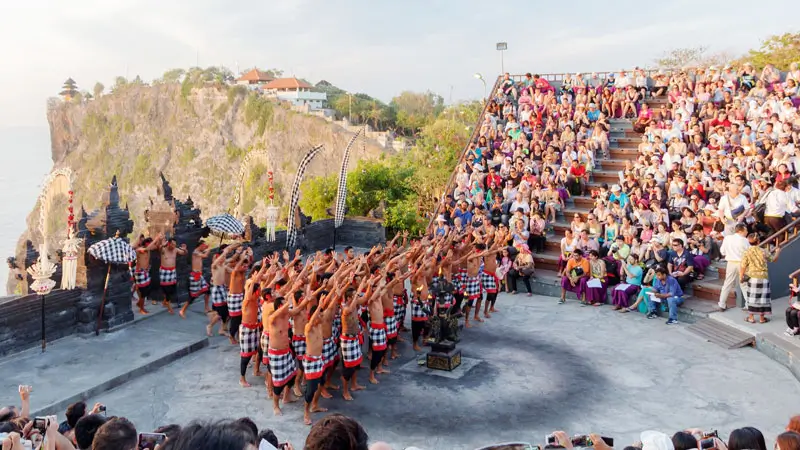
The Kecak has no orchestra. Around seventy men supply the entire soundtrack with an interlocking chant of 'cak' — Tari Kecak, in Indonesian — a form built in the 1930s from the sanghyang trance ritual and shaped in part by the German painter Walter Spies. At Pura Luhur Uluwatu that chant carries across a limestone headland high above the Indian Ocean, which is why the performance and the temple are so often quoted as a single outing. They are not. Anyone researching the Kecak Fire Dance Uluwatu tickets price is looking at two separate transactions that happen to occur within a few hundred metres of each other. The first is the temple itself. Pura Luhur Uluwatu is an active pura kahyangan jagat, one of the directional sanctuaries Balinese Hindus regard as guarding the island, and its gate fee is collected at the entrance in Pecatu before visitors reach the cliff path. The second is the performance, staged in an open-air amphitheatre set apart from the inner sanctum, where seating is normally general admission rather than numbered. That structural split explains most of the confusion in online forums: a figure quoted for a Uluwatu Temple sunset tour may cover one, both, or neither, and transport is often bundled in on top. Practically, the useful move is to treat the two as separate budget lines and confirm each before travelling rather than at the ticket window. Demand is not flat across the year. The amphitheatre fills earliest during the July and August dry-season peak, when tour coaches arrive in convoy from Seminyak, Kuta and Nusa Dua. The narrative on stage is a compressed Ramayana — Rama, Sita, the monkey general Hanuman and the fire finale that gives the show its English name. Visitors should also expect a sarong and sash at the gate, keep sunglasses and loose items away from the resident macaques, and check the site's booking pages for current availability, since the Kecak Fire Dance Uluwatu tickets price and seat release can shift with season and demand.
“The performance and the temple are so often quoted as a single outing. They are not.”
The official admission cost for Uluwatu Temple is the foreign adult gate fee. This page is about the temple’s official entrance fee, not third-party Kecak show bundles or package pricing.
Verdict: A typical foreign adult pays IDR 60,000 at the gate, and the main variable is whether you are buying official admission only or a third-party package.
The best single window is 16:00–17:30, because it lines up with the late-afternoon light and gives you room before the Kecak performance begins at sunset. For weather, May through October is the safer seasonal choice, with lower rainfall and clearer skies than the wet months.
drier, clearer skies, 27–29°C
Best overall conditions for late-afternoon arrival and sunset viewing. The light stays usable longer, and the chance of rain is lower than in the wet season.
—
Arriving on a weekday in the 16:00–17:30 window usually gives you a calmer entry and better sunset timing. This is the sweet spot if you want the strongest light before the performance.
—
Weekend crowds build faster as sunset approaches, so the same arrival window matters even more. Aim closer to 16:00 if you want more breathing room before the evening rush.
wetter, more humid, 27–29°C
You can still visit, but rain is more likely and cloud cover can soften the sunset. In this season, earlier arrival helps protect your timing if weather slows the evening rhythm.
Verdict: Tuesday to Thursday, arrive at 16:00–17:30, ideally in May, June, July, August, September, or October.
Uluwatu Temple is in Pecatu, South Kuta, Badung Regency, Bali, Indonesia. The simplest approach is by road, since the temple sits on the Bukit Peninsula and visitors usually arrive by car, taxi, or prearranged transfer.
Drive via Jalan Raya Uluwatu toward Pecatu, then follow signs for Uluwatu Temple
Ask for Uluwatu Temple, Pecatu, South Kuta, Badung Regency, Bali, Indonesia
Use a regional bus or shuttle to the Uluwatu area, then continue by local taxi to the temple entrance
Walk only if you are staying very close in Pecatu; the temple is not practical for long-distance walking
Plan to arrive at the main temple gate, since that is the normal visitor entrance. Parking is simplest if you come earlier in the day, but for a Kecak visit the key is to allow extra time for traffic on the peninsula and for walking from the parking area to the entrance.
Uluwatu is an active Balinese sea temple, not a stage set, and the Kecak performance takes place inside its grounds during evening prayer hours. Conduct that reads as casual elsewhere can disrupt worship, so the temple enforces dress and behaviour rules at the gate.
A short run-through of what to sort out before you head to Uluwatu Temple for the Kecak performance, ordered from advance planning to the moment you arrive.
Everything you need to know about kecak fire dance uluwatu tickets price
The foreign adult gate fee is 60,000 IDR per person, and the Kecak Fire Dance ticket is separate. Plan for both costs if you want to enter the temple and watch the sunset performance.
Yes, the Kecak Fire Dance needs a separate ticket from the temple entrance fee. The performance ticket is 150,000 IDR per person, and it is not bundled with admission.
The best arrival window is 16:00–17:30, with 16:30 especially practical for getting seats before the evening crowd builds. That timing also helps you combine temple visits, sunset views, and the show without rushing.
Most visitors spend about 1 hour 30 minutes to 3 hours at Uluwatu Temple. That covers the cliff paths, outer courtyards, and the 60-minute Kecak Fire Dance.
No public buses or dedicated transit lines serve Uluwatu Temple. Visitors usually rely on taxis, private drivers, or ride-hailing apps, and cash in IDR is useful because ticket booths and drivers may not always support card or QRIS payments.
The temple entry fee is separate from the performance ticket. If you are only going to the show, the dance ticket still applies, and if you enter the temple too, the 60,000 IDR gate fee is added.
Yes, children can attend the temple visit and the Kecak performance, but the general temple admission has a lower child rate in some sources. For the show, check the booking details on the day because seating and availability can tighten before sunset.
The biggest mistake is arriving too late and assuming you can buy the dance ticket at the last minute. Seats often fill early, so visitors who wait until after 17:00 can miss the best availability and the sunset timing.